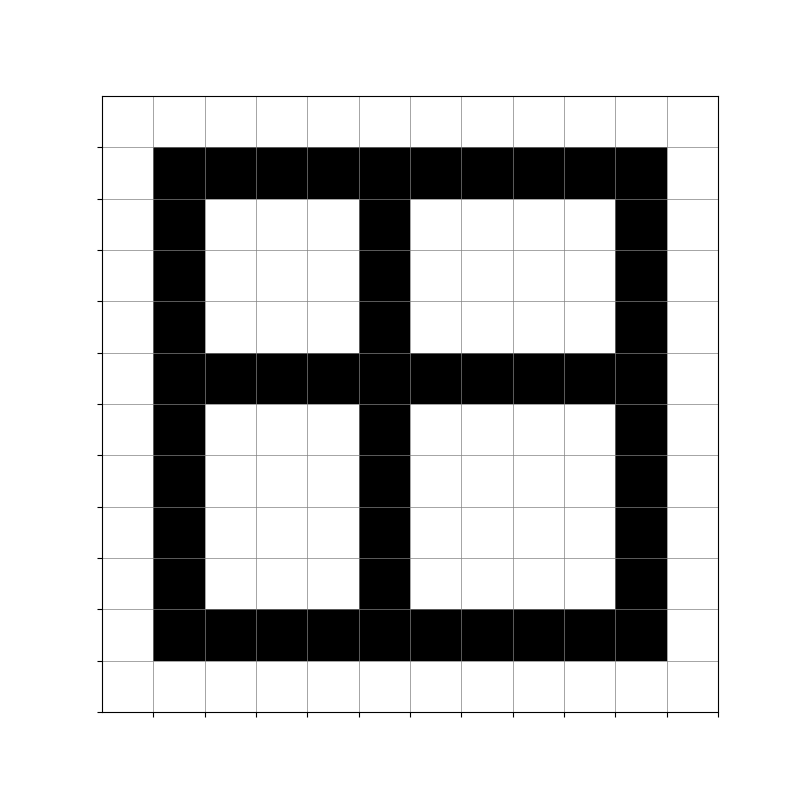
Little z has an infinite grid.
He wants to cover some rectangles on the grid. The top-left corner of the $i$-th rectangle is at grid coordinates $(x1_i, y1_i)$, and the bottom-right corner is at $(x2_i, y2_i)$.
Now, little z wants to know how many connected components the uncovered grid cells form. If two uncovered cells share an edge, they belong to the same connected component.
Specifically, the infinite region extending to the outermost boundary is also considered a connected component. For example, if there are no covered rectangles, the answer is 1.
Input
The first line contains an integer $n$ ($1 \le n \le 10^5$).
Each of the next $n$ lines contains 4 space-separated integers $x1_i, x2_i, y1_i, y2_i$, where $1 \le x1_i \le x2_i \le 10^9$ and $1 \le y1_i \le y2_i \le 10^9$.
Output
Output a single integer representing the answer.
Examples
Input 1
1
1 1 1 1
Output 1
1
Input 2
4
1 1 1 10
1 10 1 1
1 10 10 10
10 10 1 10
Output 2
2
Input 3
6
1 1 1 10
1 10 1 1
1 10 10 10
10 10 1 10
5 5 1 10
1 10 5 5
Output 3
5
Note
For the last example, the figure formed by the covered rectangles is shown below. It can be seen that the uncovered area is divided into 5 connected components.