Little Cyan Fish loves DFS orders. Today he is studying them once more, but on undirected simple graphs rather than rooted trees.
Fix a connected undirected simple graph $G$ on $n$ vertices labeled $1$ to $n$, and a starting vertex $s$. The DFS order of $G$ from $s$ is the sequence in which the vertices are first visited by the depth-first search shown below; ties are broken by always descending into the unvisited neighbor with the smallest label, so the DFS order is unique.
Algorithm 1 The DFS order used in this problem
 1: procedure DFS(vertex x)
 2:     Mark x as visited
 3:     Append x to the end of dfs_order
 4:     for each vertex y adjacent to x in G, in ascending order of label do
 5:         if y is not yet visited then
 6:             DFS(y)
 7:         end if
 8:     end for
 9: end procedure
10:
11: procedure GENERATE(G, vertex s)
12:     Mark all vertices as unvisited
13:     Let dfs_order be an empty list
14:     DFS(s)
15:     return dfs_order
16: end procedure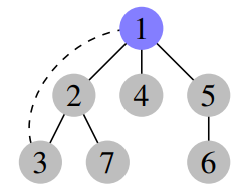
A graph with 7 vertices and 7 edges. The DFS order from vertex 1 is [1, 2, 3, 7, 4, 5, 6].
Little Cyan Fish has prepared $n$ permutations $a_1, a_2, \dots, a_n$ of $1$ to $n$. Each $a_i = [a_{i,1}, a_{i,2}, \dots, a_{i,n}]$ is what he claims would be the DFS order from vertex $i$.
Reconstruct any connected undirected simple graph $G$ on the vertices $1, 2, \dots, n$ such that the DFS order from every starting vertex $i$ equals $a_i$, or determine that no such graph exists.
Input
There are multiple test cases. The first line of the input contains a single integer $T$ ($1 \le T$), indicating the number of test cases.
For each test case, the first line contains a single integer $n$ ($1 \le n \le 200$). Each of the next $n$ lines contains $n$ integers; the $i$-th of these lines contains $a_{i,1}, a_{i,2}, \dots, a_{i,n}$ ($1 \le a_{i,j} \le n$) — the DFS order Little Cyan Fish claims is produced when the search starts from vertex $i$. It is guaranteed that $a_{i,1} = i$, and each row $a_i$ is a permutation of $1, 2, \dots, n$.
It is guaranteed that the sum of $n^2$ over all test cases does not exceed $4 \times 10^4$.
Output
For each test case, if no suitable graph exists, output a single line containing “No”.
Otherwise, output “Yes” on the first line. On the next line, output a single integer $m$ ($n - 1 \le m \le \frac{n(n-1)}{2}$) — the number of edges in your graph.
Each of the following $m$ lines must contain two integers $u$ and $v$ ($1 \le u, v \le n, u \neq v$), denoting an undirected edge between vertices $u$ and $v$. The resulting graph must be simple and connected, and its DFS order from each vertex $i$ must equal $a_i$.
If multiple graphs satisfy the requirements, output any of them.
Examples
Input 1
2
3
1 2 3
2 1 3
3 2 1
3
1 2 3
2 3 1
3 1 2
Output 1
Yes
2
1 2
2 3
No
Note
Explanation of Sample 1: In the test case, the path $1 - 2 - 3$ is a valid graph: its DFS orders starting from vertices $1, 2,$ and $3$ are $[1, 2, 3], [2, 1, 3],$ and $[3, 2, 1]$ respectively. In the second test case, no suitable graph exists.